

Overview
LlamaGuard Actions turns documented risk methodologies into continuously evaluated, typed on-chain recommendations. It observes relevant state, runs a deterministic model, and publishes the result with enough context for anyone to trace and verify it.
They shorten the time between a market changing and a protocol receiving a new risk recommendation. Governance still controls the methodology, authorized workflow, safety limits, and any path that can change protocol state.
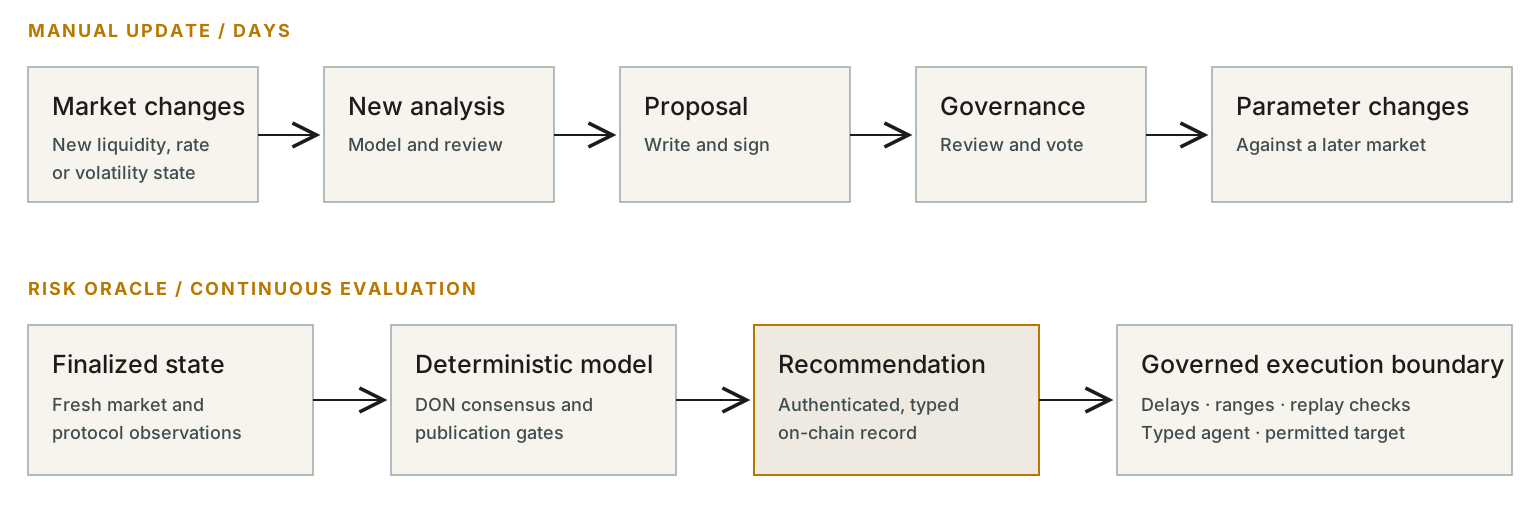
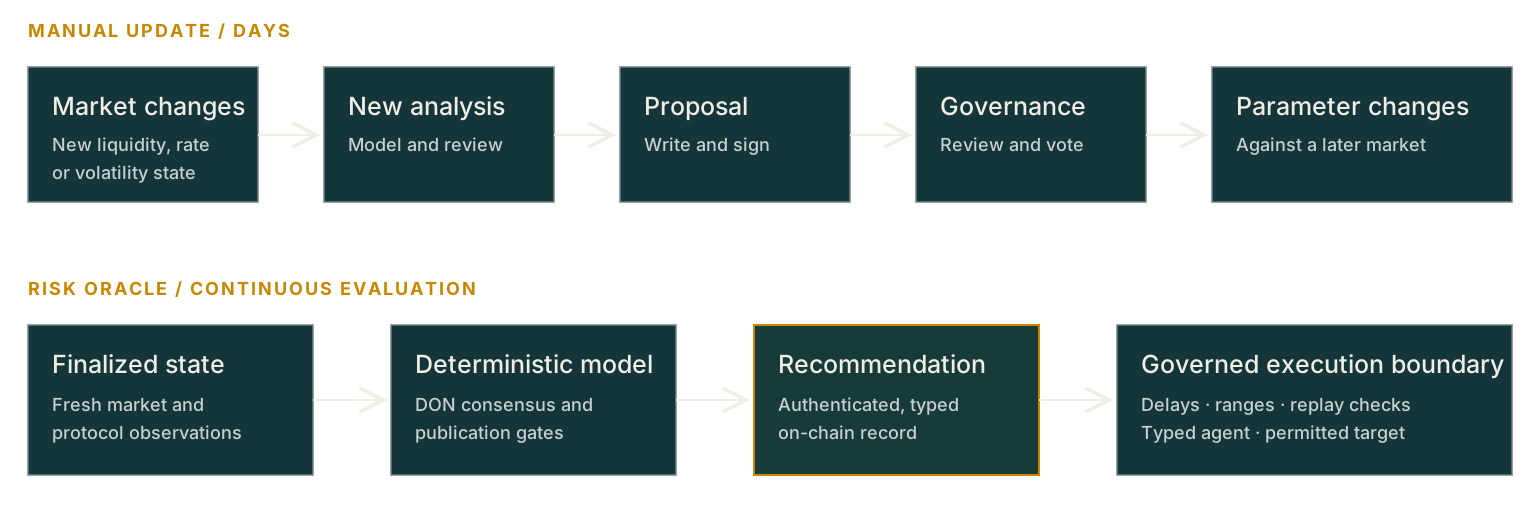
The problem is latency
Markets can reprice in minutes. A manual parameter update may require new analysis, review, proposal preparation, signatures, voting, and execution. By the time it lands, the market used for the original analysis may have changed again.
A risk oracle automates the repeatable evaluation and publication work. It does not replace governance or give the model arbitrary control over the protocol.
A risk oracle is not a price feed
| Price oracle | Risk oracle |
|---|---|
| Answers: what is this collateral worth? | Answers: how much risk may the protocol safely take, and on what terms? |
| Publishes an observed or derived price | Publishes a model-based risk recommendation |
| Feeds asset-valuation logic | Feeds monitoring, governance, or a constrained execution path |
| Represents one input to a risk decision | Combines several inputs under an explicit methodology |
Prices alone cannot determine safe borrowing power, liquidation conditions, market caps, or emergency controls. Those require a risk model and a documented safety envelope.
What a risk oracle provides
Each implementation connects a specific risk question to a documented model and a defined on-chain update type. Readers can review the methodology and source observations independently, while the authenticated on-chain record preserves the recommendation and its provenance. Timing, movement, and permission controls govern whether that record may be published or executed.
Monitoring systems and governance can use the recommendation without enabling automated execution. If execution is enabled, a dedicated agent checks the recommendation again before it may act.
Available implementations
Pendle PT
The first implementation calculates discount-rate and collateral-risk recommendations for Pendle Principal Tokens used as collateral on Aave. Go ahead and explore the Pendle PT implementation