

Overview
LlamaGuard Proof turns financial reports and their supporting evidence into signed attestations that can be checked independently. Each attestation describes what was reported, where the data came from, and which checks were performed.
The full document is stored off-chain, while its content hash and publication history are recorded on-chain. A separate verification workflow checks the attestation and publishes its own result.
Why attest financial data?
Tokenized assets often depend on information that originates outside a blockchain: portfolio statements, reserve reports, fund-manager communications, or administrator records. Publishing a number on-chain does not prove where it came from or whether the underlying evidence was altered.
LlamaGuard Proof packages the reported value together with source evidence and verification metadata. Readers can inspect the same material, reproduce the checks, and compare the result with the on-chain record.
How it works
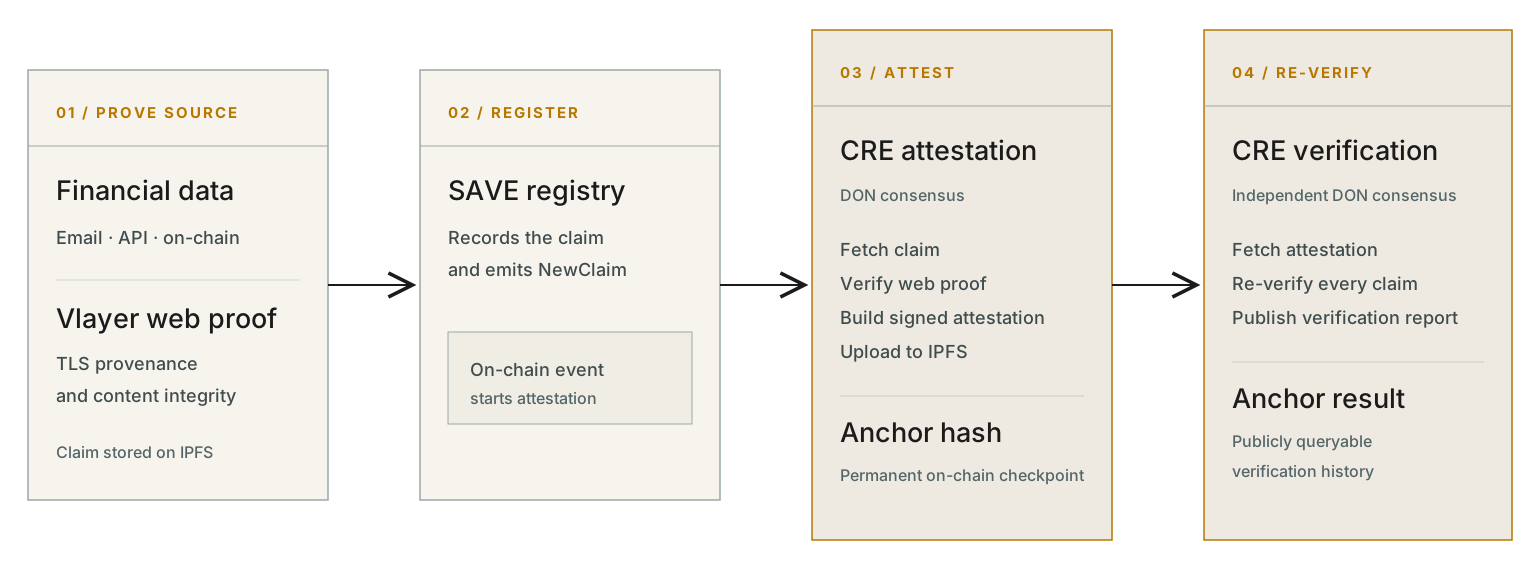
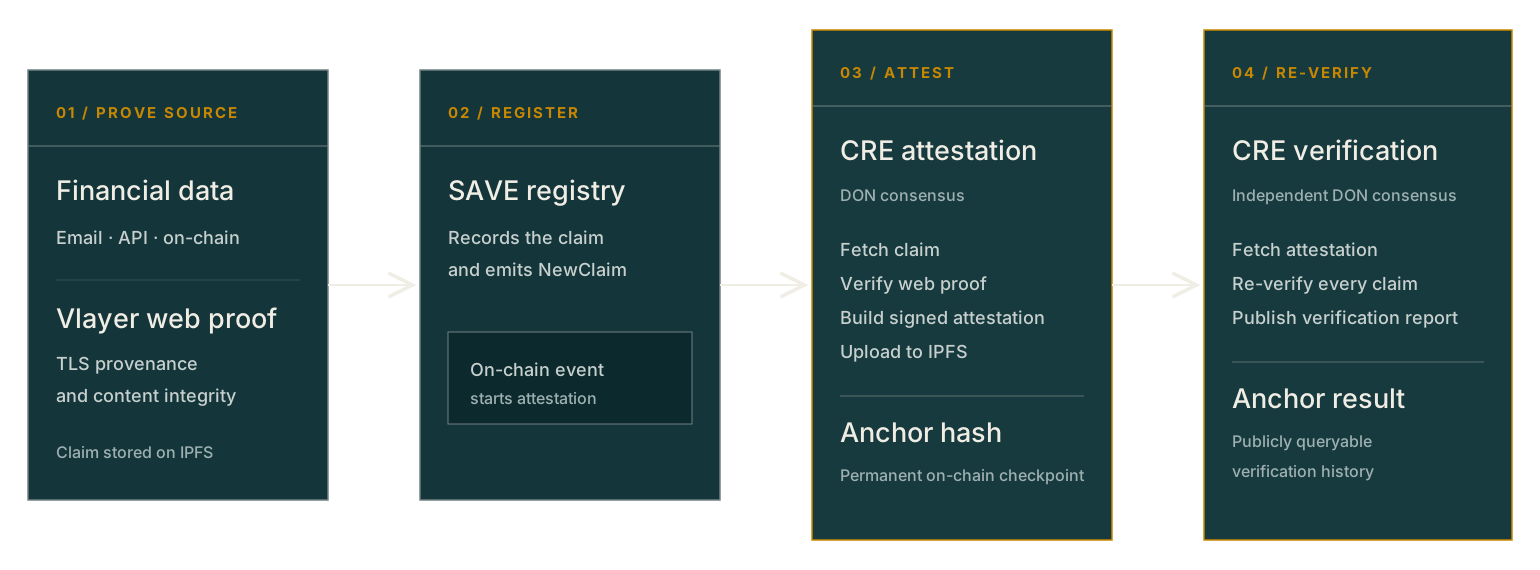
Collect source evidence
An implementation collects an approved report and the evidence needed to establish its origin. This may include authenticated API responses, signed documents, or a TLS proof for web data.
Build the attestation
A Chainlink CRE workflow validates the source material and expresses the result as typed claims. The completed attestation is signed, compressed, and stored on IPFS.
Register the content hash
The workflow writes the attestation hash to an on-chain registry. The registry preserves the proof identifier, publisher, content hash, and publication time without placing the full document on-chain.
Verify independently
A separate workflow fetches the attestation, checks its signature and claims, and publishes a verification report. Consumers can also fetch the document and perform the same checks themselves.
Core components
| Component | Responsibility |
|---|---|
| Chainlink CRE | Executes the attestation and verification workflows across DON nodes |
| Source-proof provider | Establishes where off-chain source data came from |
| SAVE data model | Defines typed claims, attestations, and verification reports |
| IPFS | Stores the complete content-addressed documents |
| On-chain registry | Records hashes, publishers, timestamps, and verification history |
Trust model
LlamaGuard Proof separates four questions that are easy to conflate:
| Question | Check |
|---|---|
| Did the report come from the expected source? | Source authentication or cryptographic source proof |
| Did the workflow process the report as specified? | Deterministic CRE execution and DON consensus |
| Does the document match the on-chain record? | Content hashing and registry lookup |
| Do the claims pass independent review? | A separate verification report with per-claim results |
An attestation proves what a defined workflow received and processed. It does not make the source infallible. Implementations can add independent data sources and comparison rules when the underlying financial claim requires them.
Implementations
Midas Proof
Midas Proof attests Net Asset Value reports for tokenized investment products. Its implementation documentation covers the source evidence, claims, cross-checks, registry, and API.
Explore the Midas Proof implementation
View attestations
LlamaGuard Proof dashboard
Browse indexed attestations and verification reports published through LlamaGuard Proof.
Continue reading
- Midas Proof documents the first implementation.
- API reference lists the endpoints used to query proofs, attestations, and verification reports.